SALA · Molecular crystals
Symmetry-constrained generation
SALAMolecular crystal generation
Complex molecular crystal generation through symmetry-constrained state–context separation
Molecular conformation, lattice geometry, and crystal packing. Generated together, guided by symmetry.
Full training and inference code and pretrained checkpoints are available.
Scroll
SALA · Molecular crystals
Symmetry-constrained generation
01 /GENERATED STRUCTURES
A closer look at crystalline order.
Selected SALA-generated structures across four chemical types and six crystal systems. Explore the different packing arrangements in three dimensions.
- Rendering
- Tubular style · custom element colours
- Cell
- 2 × 2 × 2 supercell · fully relaxed
- Atoms
- Heavy atoms only · hydrogen omitted
GENERATED CRYSTAL01 / 09
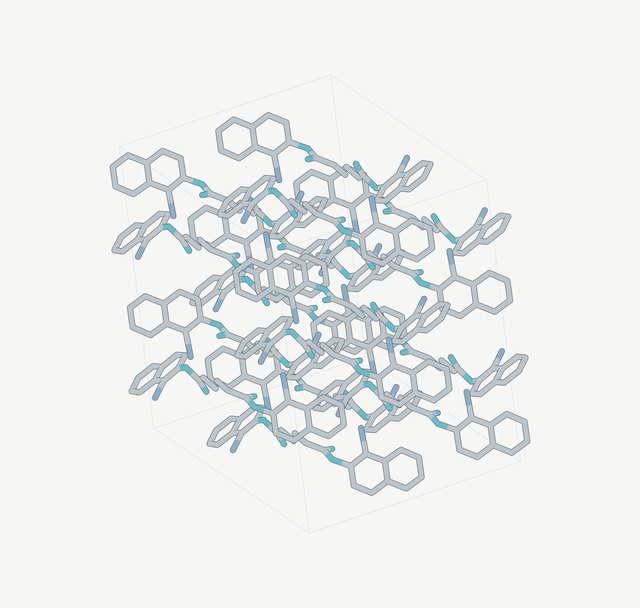
2 × 2 × 2SUPERCELL
Single-component crystal
Generation symmetry · P2₁/c
SALA · Molecular crystals
Symmetry-constrained generation
02 /SELECTED CASES
Nine generated crystals.
Filter by chemical type and generation crystal system. Every card opens an enlarged rotation with its own download.
9 of 9 cases
Monoclinic*
Metal-containing
P−1 / 2070206Single-component
P3₂ / 726779Multicomponent
P1 / 2172461Ionic
P3₁ / 939712Metal-containing
Pca2₁ / 2128532Single-component
P4₁ / 1212258Single-component
P6₁ / 1846154Ionic
P2₁ / 1518539No cases match this combination.
Tubular style · custom element coloursCNOClBrInGeSeSiCdI
2 × 2 × 2 supercells · Fully relaxed · Hydrogen atoms omitted. *Crystal systems and space groups refer to the generation condition, before relaxation.
SALA · Molecular crystals
Symmetry-constrained generation
SALATHE FRAMEWORK
A compact state.A complete crystal context.
Research overview
Molecular crystal generation must coordinate conformation, lattice geometry and periodic packing. SALA uses flow matching to evolve a compact, symmetry-constrained asymmetric-unit state while reasoning over the full periodic environment. This state–context separation enables joint generation across four chemical classes and all seven crystal systems represented in a 799-crystal held-out benchmark.
SALASymmetry-Aware Lattice and Asymmetric-unit generation
SALA's approach
Separate what needs to evolve from what the model needs to see. Symmetry connects the two.
SALA separates a symmetry-constrained generative state from full-cell context.
Evolve the independent stateGenerate only the asymmetric-unit coordinates and symmetry-compatible lattice parameters.
Reason over the full contextExpand the full cell and model periodic interactions with a structure-aware transformer.
Return to symmetryMap coordinated predictions back to the independent state through OrbitPullback.
Three quantities, one decision
Molecular crystal generation must coordinate conformation, lattice geometry and periodic packing.
Conformation
The heavy-atom geometry of the molecules inside the asymmetric unit.
Lattice geometry
Cell parameters that remain compatible with the target symmetry.
Periodic packing
How symmetry copies and neighbouring cells arrange in the full periodic environment.
SALA · Molecular crystals
Symmetry-constrained generation
03 /RESEARCH RESULTS
Crystal generation, put to the test.
Evaluated against experimental reference crystals across molecular compositions, sizes, and symmetries.
Chemical classes4Single-component, multicomponent, ionic, metal-containing
Crystal systems7All seven represented in the held-out benchmark
Candidates per target50SALA budget; the baseline uses 50–3,150
ARCHIVED PACKING-THRESHOLD HITS
575 of 799 targets have a candidate below 2 Å packing RMSD, using 50 SALA candidates per target.
Explore the evidenceHigher is better · %
050100%
Candidates per target: SALA 50 · all-atom method baseline 50–3,150
- 799
- Held-out crystals
- 72.0%
- Archived packing-threshold hits
- 1.70 Å
- Target-best packing RMSD
- 0.52 Å
- Target-best conformer RMSD
Archived hit rates use packing RMSD below 2 Å only; joint clash-free recovery has not been recomputed. Packing RMSD values are mean target-best errors on the 799-crystal benchmark, evaluated on raw generated heavy-atom structures.
SALA · Molecular crystals
Symmetry-constrained generation
04 /MANUSCRIPT FIGURES
The original evidence.
Four manuscript figures, unaltered. Each one carries its own reading note.
Recovery of molecular crystals across chemical classes and crystal systems.